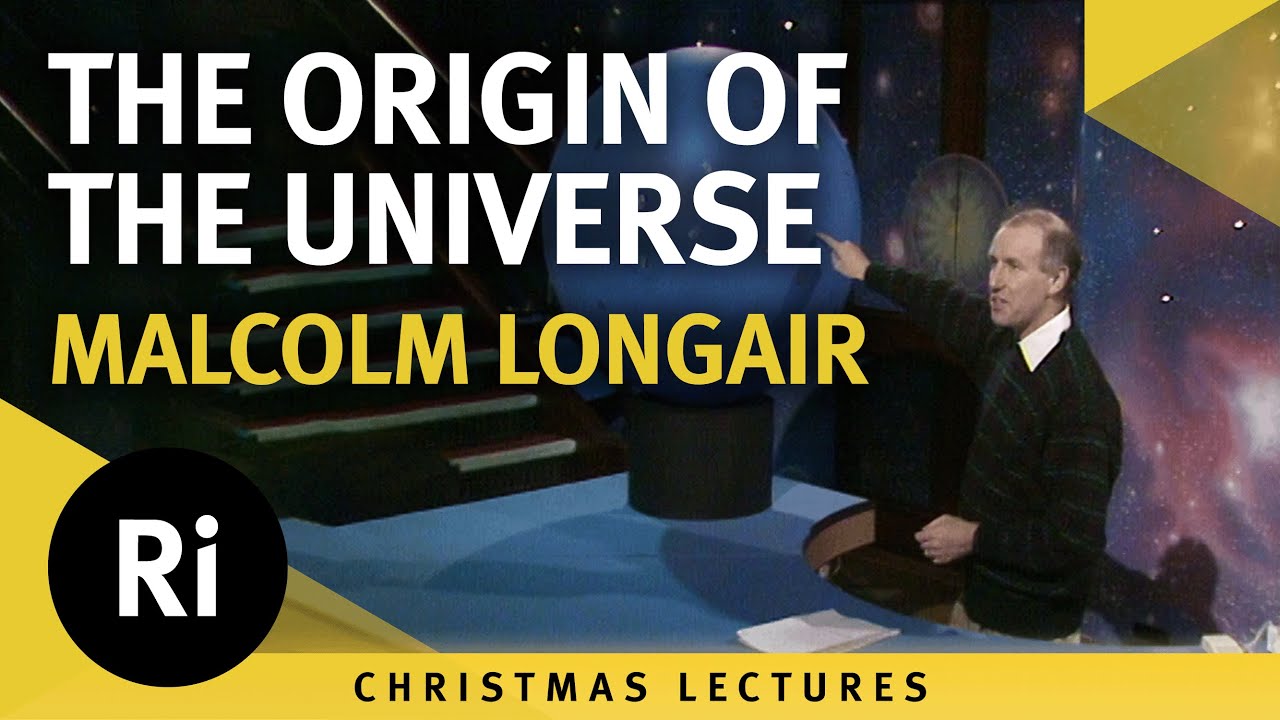
The origin of the universe – Malcolm Longair 1990 Christmas Lectures 5/5
In his final lecture Malcolm Longair explains the origins of the universe.
Watch all the lectures in this series here: https://www.youtube.com/playlist?list=PLbnrZHfNEDZy_oby1AwnVub0zqFr0Xfn2
Watch our newest Christmas lectures here: https://www.youtube.com/playlist?list=PLbnrZHfNEDZyQJZLPMjwEoOLdkFBLU2m1
This was recorded on 5 Dec 1990.
--
This year marks 200 years of the Royal Institution Christmas Lectures — a world famous series showcasing science, curiosity, and mind-blowing demos, and started by the legendary Michael Faraday himself. To celebrate, we're unlocking the archive. We're uploading all the classic lectures to our YouTube channel — some not seen since they aired on TV. Sign up as a Science Supporter and get early access here: https://www.youtube.com/channel/UCYeF244yNGuFefuFKqxIAXw/join
--
From the 1990 programme notes:
The biggest puzzle is the origin of the Universe itself. To begin, we build models of how the Universe behaves today. Luckily, this is simple—we know it’s expanding and looks the same in every direction. Gravity slows this expansion, and depending on how much matter exists, the Universe can either expand forever or collapse in a "Big Crunch." The critical density is the dividing line between these outcomes, and our Universe is very close to it—within a factor of ten. If that’s true today, it must’ve been nearly exact in the very early Universe. But why?
As we trace the Universe back, it becomes hotter and denser. Around three minutes after the Big Bang, nuclear reactions created helium, deuterium, and traces of lithium—explaining the origin of light elements. But for matter to dominate now, there had to be a tiny imbalance between matter and antimatter early on.
Another mystery is why the Universe is so uniform, even in regions that couldn't have exchanged information. The Inflationary Model, which proposes rapid early expansion, could explain this isotropy and the near-critical density. Modern particle physics may also explain the matter-antimatter imbalance and even the tiny fluctuations that led to galaxies. These insights might finally show how the vast and the tiny are deeply connected.
--
About the 1990 CHRISTMAS LECTURES
The astronomical sciences have developed out of all recognition over the last 40 years. Up till about 1950, astronomy meant optical astronomy, but now it could mean radio astronomy, X-ray astronomy, infrared and ultraviolet astronomy, γ-ray astronomy and even more exotic ways of looking at the Universe through neutrino astronomy. Each of these disciplines has contributed essential new facts about the origin and evolution of different classes of object in the Universe. These lectures aim to put all this new knowledge into a coherent picture of our present understanding of the origin and evolution of the Universe.
The astrophysical sciences are concerned with the origins of the objects we see in the Universe – planets, stars, galaxies, quasars, the large scale structure of the Universe and the Universe itself. There have been enormous advances in all these areas over recent years with the development of the new technologies which enable sensitive observations to be undertaken in the new wavebands.
To solve the problems of the origins of astronomical systems, we must call upon an enormous range of physical tools to understand what it is we have to explain. We need to introduce many ideas from simple physics in order to define precisely the astrophysical problems which have to be solved. We will introduce these ideas as the lectures develop – we will need ideas like Newton’s law of gravity, the conservation of angular momentum, Einstein’s E = mc2, simple ideas about black holes and nuclear reactions in stars. We will introduce much of the essential physics through demonstrations, models and analogies. By the end of the lectures, we will not have answered the question of the origins of all the contents of the Universe but we will have gained an understanding of what the key questions are which still need to be addressed.
Find out more about the CHRISTMAS LECTURES here: https://www.rigb.org/christmas-lectures
---
Join this channel to get access to perks:
https://www.youtube.com/channel/UCYeF244yNGuFefuFKqxIAXw/join
Subscribe for regular science videos: http://bit.ly/RiSubscRibe
The Ri is on Twitter: http://twitter.com/ri_science
and Facebook: http://www.facebook.com/royalinstitution
and TikTok: https://www.tiktok.com/@ri_science
Listen to the Ri podcast: https://podcasters.spotify.com/pod/show/ri-science-podcast
Donate to the RI and help us bring you more lectures: https://www.rigb.org/support-us/donate-ri
Our editorial policy: https://www.rigb.org/editing-ri-talks-and-moderating-comments
Subscribe for the latest science videos: http://bit.ly/RiNewsletter
Product links on this page may be affiliate links which means it won't cost you any extra but we may earn a small commission if you decide to purchase through the link.
Watch all the lectures in this series here: https://www.youtube.com/playlist?list=PLbnrZHfNEDZy_oby1AwnVub0zqFr0Xfn2
Watch our newest Christmas lectures here: https://www.youtube.com/playlist?list=PLbnrZHfNEDZyQJZLPMjwEoOLdkFBLU2m1
This was recorded on 5 Dec 1990.
--
This year marks 200 years of the Royal Institution Christmas Lectures — a world famous series showcasing science, curiosity, and mind-blowing demos, and started by the legendary Michael Faraday himself. To celebrate, we're unlocking the archive. We're uploading all the classic lectures to our YouTube channel — some not seen since they aired on TV. Sign up as a Science Supporter and get early access here: https://www.youtube.com/channel/UCYeF244yNGuFefuFKqxIAXw/join
--
From the 1990 programme notes:
The biggest puzzle is the origin of the Universe itself. To begin, we build models of how the Universe behaves today. Luckily, this is simple—we know it’s expanding and looks the same in every direction. Gravity slows this expansion, and depending on how much matter exists, the Universe can either expand forever or collapse in a "Big Crunch." The critical density is the dividing line between these outcomes, and our Universe is very close to it—within a factor of ten. If that’s true today, it must’ve been nearly exact in the very early Universe. But why?
As we trace the Universe back, it becomes hotter and denser. Around three minutes after the Big Bang, nuclear reactions created helium, deuterium, and traces of lithium—explaining the origin of light elements. But for matter to dominate now, there had to be a tiny imbalance between matter and antimatter early on.
Another mystery is why the Universe is so uniform, even in regions that couldn't have exchanged information. The Inflationary Model, which proposes rapid early expansion, could explain this isotropy and the near-critical density. Modern particle physics may also explain the matter-antimatter imbalance and even the tiny fluctuations that led to galaxies. These insights might finally show how the vast and the tiny are deeply connected.
--
About the 1990 CHRISTMAS LECTURES
The astronomical sciences have developed out of all recognition over the last 40 years. Up till about 1950, astronomy meant optical astronomy, but now it could mean radio astronomy, X-ray astronomy, infrared and ultraviolet astronomy, γ-ray astronomy and even more exotic ways of looking at the Universe through neutrino astronomy. Each of these disciplines has contributed essential new facts about the origin and evolution of different classes of object in the Universe. These lectures aim to put all this new knowledge into a coherent picture of our present understanding of the origin and evolution of the Universe.
The astrophysical sciences are concerned with the origins of the objects we see in the Universe – planets, stars, galaxies, quasars, the large scale structure of the Universe and the Universe itself. There have been enormous advances in all these areas over recent years with the development of the new technologies which enable sensitive observations to be undertaken in the new wavebands.
To solve the problems of the origins of astronomical systems, we must call upon an enormous range of physical tools to understand what it is we have to explain. We need to introduce many ideas from simple physics in order to define precisely the astrophysical problems which have to be solved. We will introduce these ideas as the lectures develop – we will need ideas like Newton’s law of gravity, the conservation of angular momentum, Einstein’s E = mc2, simple ideas about black holes and nuclear reactions in stars. We will introduce much of the essential physics through demonstrations, models and analogies. By the end of the lectures, we will not have answered the question of the origins of all the contents of the Universe but we will have gained an understanding of what the key questions are which still need to be addressed.
Find out more about the CHRISTMAS LECTURES here: https://www.rigb.org/christmas-lectures
---
Join this channel to get access to perks:
https://www.youtube.com/channel/UCYeF244yNGuFefuFKqxIAXw/join
Subscribe for regular science videos: http://bit.ly/RiSubscRibe
The Ri is on Twitter: http://twitter.com/ri_science
and Facebook: http://www.facebook.com/royalinstitution
and TikTok: https://www.tiktok.com/@ri_science
Listen to the Ri podcast: https://podcasters.spotify.com/pod/show/ri-science-podcast
Donate to the RI and help us bring you more lectures: https://www.rigb.org/support-us/donate-ri
Our editorial policy: https://www.rigb.org/editing-ri-talks-and-moderating-comments
Subscribe for the latest science videos: http://bit.ly/RiNewsletter
Product links on this page may be affiliate links which means it won't cost you any extra but we may earn a small commission if you decide to purchase through the link.

The Royal Institution
Videos to make you think more deeply about science. Explosive short films, full length talks from the world’s leading scientists and writers, and videos to challenge the way you look at the world.
The Royal Institution is a 200 year old independent chari...
Science, strings and symphonies – Charles Taylor’s 1989 Christmas Lectures 3/5
The Royal Institution
Did Kathleen Lonsdale deserve a Nobel Prize? Her groundbreaking work explained
The Royal Institution