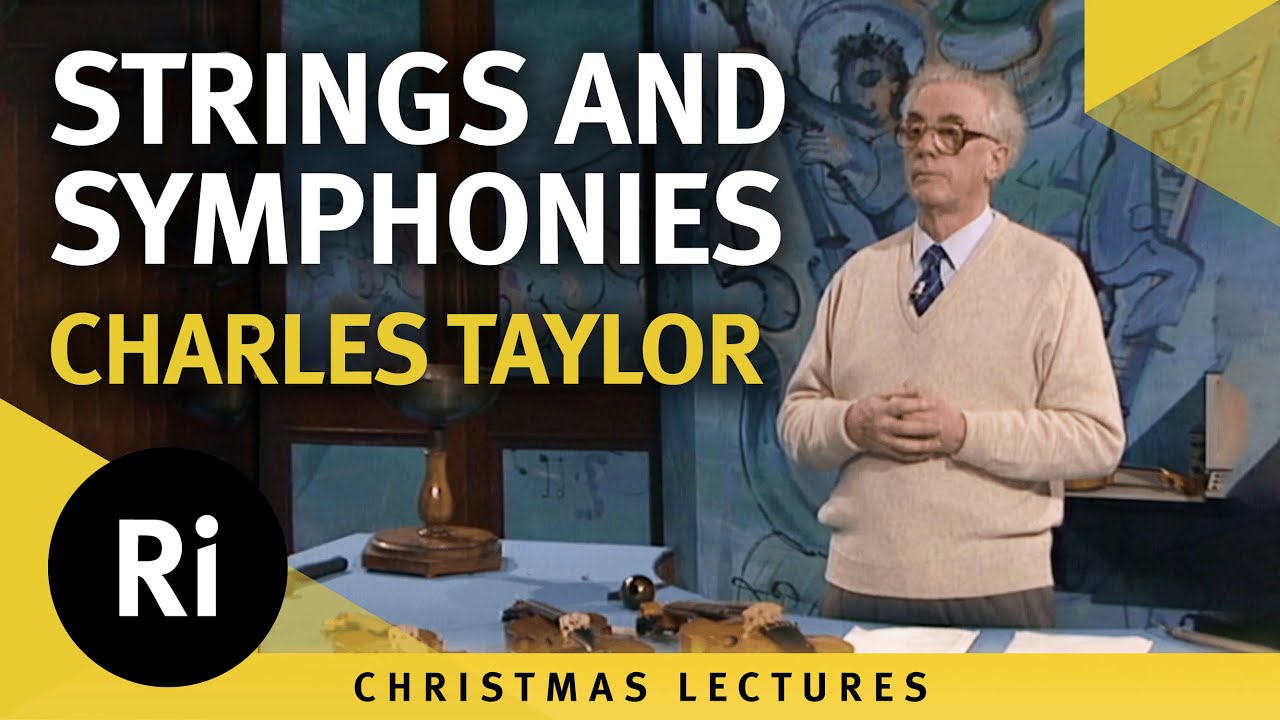
Science, strings and symphonies – Charles Taylor’s 1989 Christmas Lectures 3/5
In his third lecture, Charles Taylor explores how flat plates and hollow bodies work in amplifying sounds.
Watch all the lectures in this series here: https://www.youtube.com/playlist?list=PLbnrZHfNEDZywm9-OxvqPpP8RnE4dQnXY
Watch our newest Christmas lectures here: https://www.youtube.com/playlist?list=PLbnrZHfNEDZyQJZLPMjwEoOLdkFBLU2m1
This was recorded on 3 Dec 1989.
--
This year marks 200 years of the Royal Institution Christmas Lectures — a world famous series showcasing science, curiosity, and mind-blowing demos, and started by the legendary Michael Faraday himself. To celebrate, we're unlocking the archive. Every Saturday, we’ll upload a classic lecture to our YouTube channel — some not seen since they aired on TV. Sign up as a Science Supporter and get early access here: https://www.youtube.com/channel/UCYeF244yNGuFefuFKqxIAXw/join
--
From the 1989 programme notes:
All stringed instruments start out with very quiet string vibrations that need amplifying, and we shall start by looking at the way in which flat plates and hollow bodies work in amplifying sounds.
Our exploration of musical instruments will cover two different groups that both use strings as their primary source of sound. The first group uses plucking as the way of setting the strings in vibration and includes all the fascinating instruments like lyres and lutes that have eventually led up to modern harps and guitars.
Science has begun to contribute to our knowledge of the way in which guitars work and computer techniques are now being used to show how the top plate of a guitar vibrates when a string is plucked.
The second group is one of the largest families of instruments, bowed strings, which derive from the quiet viols. Then came the baroque violins, cellos and other related instruments.
But as orchestras became larger and composers of symphonies and concertos demanded a more powerful sound, the baroque instruments were rebuilt to give our present day violins and cellos. Even the great instruments of Antonio Stradivari are no longer in their original form. And yet there is still a magic about them.
Can science help to reveal the secret of the 'Strad'? How far can scientific methods complement the skill of the craftsman in making instruments? Among other, modern developments we shall see how the latest advances in laser interferometry can reveal not only how instruments behave, but how the body of the player is involved too.
--
About the 1989 CHRISTMAS LECTURES
All stringed instruments start out with very quiet string vibrations that need amplifying, and we shall start by looking at the way in which flat plates and hollow bodies work in amplifying sounds.
Our exploration of musical instruments will cover two different groups that both use strings as their primary source of sound. The first group uses plucking as the way of setting the strings in vibration and includes all the fascinating instruments like lyres and lutes that have eventually led up to modern harps and guitars.
Science has begun to contribute to our knowledge of the way in which guitars work and computer techniques are now being used to show how the top plate of a guitar vibrates when a string is plucked.
The second group is one of the largest families of instruments, bowed strings, which derive from the quiet viols. Then came the baroque violins, cellos and other related instruments.
But as orchestras became larger and composers of symphonies and concertos demanded a more powerful sound, the baroque instruments were rebuilt to give our present day violins and cellos. Even the great instruments of Antonio Stradivari are no longer in their original form. And yet there is still a magic about them.
Can science help to reveal the secret of the 'Strad'? How far can scientific methods complement the skill of the craftsman in making instruments? We shall see how the latest advances in laser interferometry can reveal not only how instruments behave, but how the body of the player is involved too.
Find out more about the CHRISTMAS LECTURES here: https://www.rigb.org/christmas-lectures
---
Join this channel to get access to perks:
https://www.youtube.com/channel/UCYeF244yNGuFefuFKqxIAXw/join
Subscribe for regular science videos: http://bit.ly/RiSubscRibe
The Ri is on Twitter: http://twitter.com/ri_science
and Facebook: http://www.facebook.com/royalinstitution
and TikTok: https://www.tiktok.com/@ri_science
Listen to the Ri podcast: https://podcasters.spotify.com/pod/show/ri-science-podcast
Donate to the RI and help us bring you more lectures: https://www.rigb.org/support-us/donate-ri
Our editorial policy: https://www.rigb.org/editing-ri-talks-and-moderating-comments
Subscribe for the latest science videos: http://bit.ly/RiNewsletter
Product links on this page may be affiliate links which means it won't cost you any extra but we may earn a small commission if you decide to purchase through the link.
Watch all the lectures in this series here: https://www.youtube.com/playlist?list=PLbnrZHfNEDZywm9-OxvqPpP8RnE4dQnXY
Watch our newest Christmas lectures here: https://www.youtube.com/playlist?list=PLbnrZHfNEDZyQJZLPMjwEoOLdkFBLU2m1
This was recorded on 3 Dec 1989.
--
This year marks 200 years of the Royal Institution Christmas Lectures — a world famous series showcasing science, curiosity, and mind-blowing demos, and started by the legendary Michael Faraday himself. To celebrate, we're unlocking the archive. Every Saturday, we’ll upload a classic lecture to our YouTube channel — some not seen since they aired on TV. Sign up as a Science Supporter and get early access here: https://www.youtube.com/channel/UCYeF244yNGuFefuFKqxIAXw/join
--
From the 1989 programme notes:
All stringed instruments start out with very quiet string vibrations that need amplifying, and we shall start by looking at the way in which flat plates and hollow bodies work in amplifying sounds.
Our exploration of musical instruments will cover two different groups that both use strings as their primary source of sound. The first group uses plucking as the way of setting the strings in vibration and includes all the fascinating instruments like lyres and lutes that have eventually led up to modern harps and guitars.
Science has begun to contribute to our knowledge of the way in which guitars work and computer techniques are now being used to show how the top plate of a guitar vibrates when a string is plucked.
The second group is one of the largest families of instruments, bowed strings, which derive from the quiet viols. Then came the baroque violins, cellos and other related instruments.
But as orchestras became larger and composers of symphonies and concertos demanded a more powerful sound, the baroque instruments were rebuilt to give our present day violins and cellos. Even the great instruments of Antonio Stradivari are no longer in their original form. And yet there is still a magic about them.
Can science help to reveal the secret of the 'Strad'? How far can scientific methods complement the skill of the craftsman in making instruments? Among other, modern developments we shall see how the latest advances in laser interferometry can reveal not only how instruments behave, but how the body of the player is involved too.
--
About the 1989 CHRISTMAS LECTURES
All stringed instruments start out with very quiet string vibrations that need amplifying, and we shall start by looking at the way in which flat plates and hollow bodies work in amplifying sounds.
Our exploration of musical instruments will cover two different groups that both use strings as their primary source of sound. The first group uses plucking as the way of setting the strings in vibration and includes all the fascinating instruments like lyres and lutes that have eventually led up to modern harps and guitars.
Science has begun to contribute to our knowledge of the way in which guitars work and computer techniques are now being used to show how the top plate of a guitar vibrates when a string is plucked.
The second group is one of the largest families of instruments, bowed strings, which derive from the quiet viols. Then came the baroque violins, cellos and other related instruments.
But as orchestras became larger and composers of symphonies and concertos demanded a more powerful sound, the baroque instruments were rebuilt to give our present day violins and cellos. Even the great instruments of Antonio Stradivari are no longer in their original form. And yet there is still a magic about them.
Can science help to reveal the secret of the 'Strad'? How far can scientific methods complement the skill of the craftsman in making instruments? We shall see how the latest advances in laser interferometry can reveal not only how instruments behave, but how the body of the player is involved too.
Find out more about the CHRISTMAS LECTURES here: https://www.rigb.org/christmas-lectures
---
Join this channel to get access to perks:
https://www.youtube.com/channel/UCYeF244yNGuFefuFKqxIAXw/join
Subscribe for regular science videos: http://bit.ly/RiSubscRibe
The Ri is on Twitter: http://twitter.com/ri_science
and Facebook: http://www.facebook.com/royalinstitution
and TikTok: https://www.tiktok.com/@ri_science
Listen to the Ri podcast: https://podcasters.spotify.com/pod/show/ri-science-podcast
Donate to the RI and help us bring you more lectures: https://www.rigb.org/support-us/donate-ri
Our editorial policy: https://www.rigb.org/editing-ri-talks-and-moderating-comments
Subscribe for the latest science videos: http://bit.ly/RiNewsletter
Product links on this page may be affiliate links which means it won't cost you any extra but we may earn a small commission if you decide to purchase through the link.

The Royal Institution
Videos to make you think more deeply about science. Explosive short films, full length talks from the world’s leading scientists and writers, and videos to challenge the way you look at the world.
The Royal Institution is a 200 year old independent chari...
Science, strings and symphonies – Charles Taylor’s 1989 Christmas Lectures 3/5
The Royal Institution
Did Kathleen Lonsdale deserve a Nobel Prize? Her groundbreaking work explained
The Royal Institution