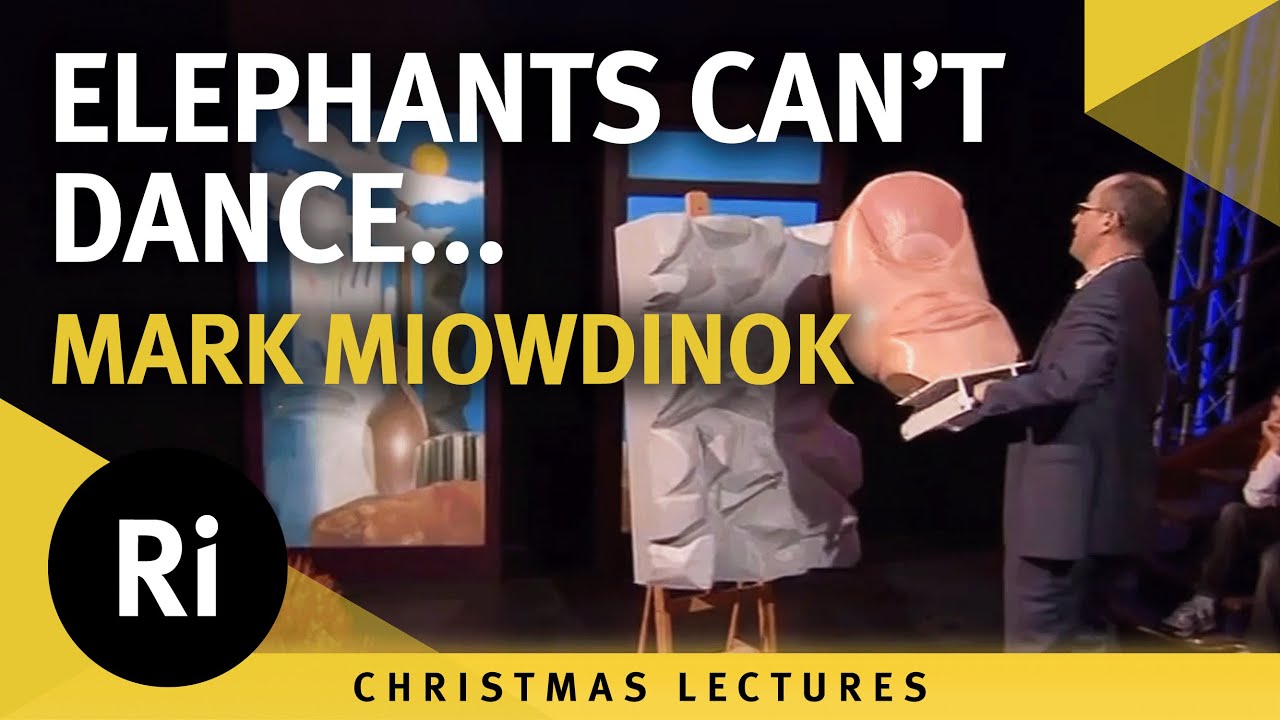
Elephants can't dance, but hamsters can - Mark Miodownik 2010 Christmas Lectures 1/3
From the very large to the very small, size is an important factor for both living and non-living matter.
Watch all the lectures in this series here: https://www.youtube.com/playlist?list=PLbnrZHfNEDZyF-cHd3rdBU8cOttWEEaMK
Watch our newest Christmas lectures here: https://www.youtube.com/playlist?list=PLbnrZHfNEDZyQJZLPMjwEoOLdkFBLU2m1
This was recorded on 1 Dec 2010.
--
This year marks 200 years of the Royal Institution Christmas Lectures — a world famous series showcasing science, curiosity, and mind-blowing demos, and started by the legendary Michael Faraday himself. To celebrate, we're unlocking the archive. Every week, we’ll upload a classic lecture to our YouTube channel — some not seen since they aired on TV. Sign up as a Science Supporter and get early access here: https://www.youtube.com/channel/UCYeF244yNGuFefuFKqxIAXw/join
--
About Lecture 1:
If a hamster and a human both fall from a skyscraper, why would the hamster fare better? Why can’t elephants dance and how strong are ants compared to humans? By exploring the physical rules that govern the animal kingdom, Mark Miodownik reveals how size governs the strength, life span and dance moves of animals.
We are all familiar with watching ants labouring for hours on a hot sunny day lifting crumbs or dragging bits of leaf back to their ant hill – but have you ever wondered how hard it is for them? They are often carrying 300 times their own weight, which is impressive when you consider that the world's strongest man can only lift three or four times his own weight.
Are the materials that make up ant muscles much better than ours, or are we just not trying hard enough?
In the first of his CHRISTMAS LECTURES Mark Miodownik reveals how the amount of sleep mammals need is in proportion to their size, and how all animals have the same number of heartbeats, but mice use them up quicker than elephants.
--
About the 2010 CHRISTMAS LECTURES
From the very large to the very small, size is an important factor for both living and non-living matter.
Beginning his journey into the world of scale with a furry friend, Mark reveals why hamsters fare better than humans when jumping from the top of a skyscraper. We find out why mountains don't grow any taller, why the size of an elephant means it has trouble dancing, and why ants can lift many times their own body weight.
Scaling down to the molecular level, Mark Miodownik reveals why chocolate tastes so good and returns to size again to explain how sperm whales – one of the world’s biggest animals – have developed nifty ways of diving deep into the ocean
Find out more about the CHRISTMAS LECTURES here: https://www.rigb.org/christmas-lectures
---
Join this channel to get access to perks:
https://www.youtube.com/channel/UCYeF244yNGuFefuFKqxIAXw/join
Subscribe for regular science videos: http://bit.ly/RiSubscRibe
The Ri is on Twitter: http://twitter.com/ri_science
and Facebook: http://www.facebook.com/royalinstitution
and TikTok: https://www.tiktok.com/@ri_science
Listen to the Ri podcast: https://podcasters.spotify.com/pod/show/ri-science-podcast
Donate to the RI and help us bring you more lectures: https://www.rigb.org/support-us/donate-ri
Our editorial policy: https://www.rigb.org/editing-ri-talks-and-moderating-comments
Subscribe for the latest science videos: http://bit.ly/RiNewsletter
Product links on this page may be affiliate links which means it won't cost you any extra but we may earn a small commission if you decide to purchase through the link.
Watch all the lectures in this series here: https://www.youtube.com/playlist?list=PLbnrZHfNEDZyF-cHd3rdBU8cOttWEEaMK
Watch our newest Christmas lectures here: https://www.youtube.com/playlist?list=PLbnrZHfNEDZyQJZLPMjwEoOLdkFBLU2m1
This was recorded on 1 Dec 2010.
--
This year marks 200 years of the Royal Institution Christmas Lectures — a world famous series showcasing science, curiosity, and mind-blowing demos, and started by the legendary Michael Faraday himself. To celebrate, we're unlocking the archive. Every week, we’ll upload a classic lecture to our YouTube channel — some not seen since they aired on TV. Sign up as a Science Supporter and get early access here: https://www.youtube.com/channel/UCYeF244yNGuFefuFKqxIAXw/join
--
About Lecture 1:
If a hamster and a human both fall from a skyscraper, why would the hamster fare better? Why can’t elephants dance and how strong are ants compared to humans? By exploring the physical rules that govern the animal kingdom, Mark Miodownik reveals how size governs the strength, life span and dance moves of animals.
We are all familiar with watching ants labouring for hours on a hot sunny day lifting crumbs or dragging bits of leaf back to their ant hill – but have you ever wondered how hard it is for them? They are often carrying 300 times their own weight, which is impressive when you consider that the world's strongest man can only lift three or four times his own weight.
Are the materials that make up ant muscles much better than ours, or are we just not trying hard enough?
In the first of his CHRISTMAS LECTURES Mark Miodownik reveals how the amount of sleep mammals need is in proportion to their size, and how all animals have the same number of heartbeats, but mice use them up quicker than elephants.
--
About the 2010 CHRISTMAS LECTURES
From the very large to the very small, size is an important factor for both living and non-living matter.
Beginning his journey into the world of scale with a furry friend, Mark reveals why hamsters fare better than humans when jumping from the top of a skyscraper. We find out why mountains don't grow any taller, why the size of an elephant means it has trouble dancing, and why ants can lift many times their own body weight.
Scaling down to the molecular level, Mark Miodownik reveals why chocolate tastes so good and returns to size again to explain how sperm whales – one of the world’s biggest animals – have developed nifty ways of diving deep into the ocean
Find out more about the CHRISTMAS LECTURES here: https://www.rigb.org/christmas-lectures
---
Join this channel to get access to perks:
https://www.youtube.com/channel/UCYeF244yNGuFefuFKqxIAXw/join
Subscribe for regular science videos: http://bit.ly/RiSubscRibe
The Ri is on Twitter: http://twitter.com/ri_science
and Facebook: http://www.facebook.com/royalinstitution
and TikTok: https://www.tiktok.com/@ri_science
Listen to the Ri podcast: https://podcasters.spotify.com/pod/show/ri-science-podcast
Donate to the RI and help us bring you more lectures: https://www.rigb.org/support-us/donate-ri
Our editorial policy: https://www.rigb.org/editing-ri-talks-and-moderating-comments
Subscribe for the latest science videos: http://bit.ly/RiNewsletter
Product links on this page may be affiliate links which means it won't cost you any extra but we may earn a small commission if you decide to purchase through the link.

The Royal Institution
Videos to make you think more deeply about science. Explosive short films, full length talks from the world’s leading scientists and writers, and videos to challenge the way you look at the world.
The Royal Institution is a 200 year old independent chari...
Science, strings and symphonies – Charles Taylor’s 1989 Christmas Lectures 3/5
The Royal Institution
Did Kathleen Lonsdale deserve a Nobel Prize? Her groundbreaking work explained
The Royal Institution