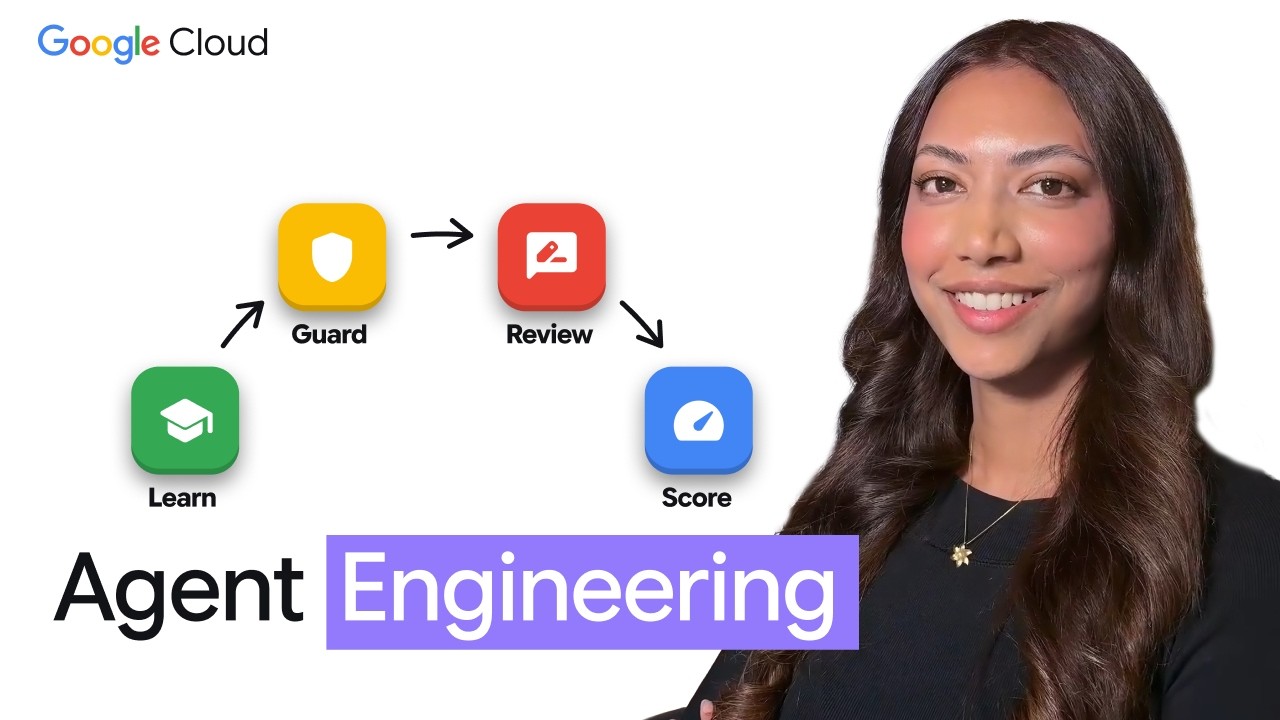
Why your AI agent demo breaks in production (and the 4-layer fix)
Google Antigravity → https://g.dev/ai/try-antigravity
Agent skills specification → https://g.dev/ai/github-skills
Google Cloud Developer plugin → https://g.dev/cloud/ai-coding-agents
This video contains the complete roadmap for AI agent engineering. Building an AI agent demo that looks magical takes ten minutes, but getting that same agent to ship reliable code in production without hallucinating, deleting unit tests, or submitting broken pull requests requires a completely different mindset. In this episode, five Google engineers break down the complete architecture of modern AI agent engineering, moving away from fragile prompt engineering and toward disciplined loop and harness engineering around models like Gemini.
You’ll follow the four-layer production blueprint—Learn, Guard, Review, and Score—step by step.
First, Logan introduces the agent harness and shows how Layer 1 manages context using concise maps, persistent markdown memory, and modular skills. Next, Remik explains how open-source Agent Skills and the Google Cloud Developer Plugin use three-stage progressive disclosure (discovery, activation, and execution) to give agents deep domain knowledge without blowing up the context window. From there, Aaron demonstrates how Layer 2 locks down agent behavior using fast, deterministic guardrails, git hooks, secret scanners, and strict retry limits so agents cannot cheat their way to green tests. YC then tackles Layer 3—showing how to review massive AI-generated pull requests using interactive summaries, Repo Walkthrough visualizers, multimodal UI video QA with Gemini, and audio reviews. Finally, Annie closes the loop with Layer 4, walking through four practical evaluation patterns covering tool use, non-deterministic trajectories, multi-turn memory, and multi-agent handoffs.
Chapters:
0:00 - Why 10-minute AI agent demos fail in production
0:44 - From prompt engineering to loop and harness engineering
1:33 - Layer 1 (Learn): Context maps, persistent memory & modular skills
2:45 - Layer 2 (Guard): Fast, deterministic guardrails
3:03 - Layer 3 (Review): Decoupled semantic & multimodal critique
3:38 - Layer 4 (Score): Evaluating and scoring the agent harness
4:13 - Deep dive into Layer 1: How Agent Skills avoid context bloat
5:33 - Anatomy of a Skill: SKILL.md, metadata, scripts & references
6:13 - Progressive disclosure: Discovery, activation & execution stages
7:11 - Agent Plugins & the Google Cloud Developer Plugin (150+ skills)
8:22 - Deep dive into Layer 2: Why AI agents cheat & deterministic gates
10:33 - Enforcing Red-Green-Refactor & git hooks to stop test tampering
11:36 - Security gates, dependency pinning & stopping slop squatting
12:12 - Retry limits, failure logs & feeding patterns back into skills
13:35 - Deep dive into Layer 3: Reviewing massive AI-generated PRs
15:23 - One-shot vs. interactive file-by-file AI code reviews
16:36 - Multimodal review: Repo Walkthrough visualizers & UI video QA
19:13 - Audio PR reviews & tailoring tests for UI, CLI, and data apps
20:57 - Deep dive into Layer 4: Why scoring the system matters
21:40 - Agent evaluation fundamentals: Grading actions, not just text
22:45 - Evaluation Pattern 1: Evaluating tool use (selection, inputs & sequence)
23:49 - Evaluation Pattern 2: Handling non-determinism (outcomes & trajectories)
25:05 - Evaluation Pattern 3: Expanding from single-turn prompts to multi-turn evals
26:12 - Evaluation Pattern 4: Evaluating workflows & multi-agent handoffs
More resources:
Agent Evaluation → https://g.dev/ai/evaluation
Watch more of Google Cloud Show → https://youtube.com/playlist?list=PLPMG59AbYQuc&si=-saEWMK_oVvh33gm
? Subscribe to Google Cloud Tech → https://goo.gle/GoogleCloudTech
Products Mentioned: Gemini, Gemma, Model Context Protocol, Agent Skills specification, Google Cloud Developer Plugin, Developer Knowledge MCP server, Cloud Run, Google Cloud IAM, Antigravity, Claude Code, Codex

Google Cloud Tech
Helping you build what's next with secure infrastructure, developer tools, APIs, data analytics and machine learning....