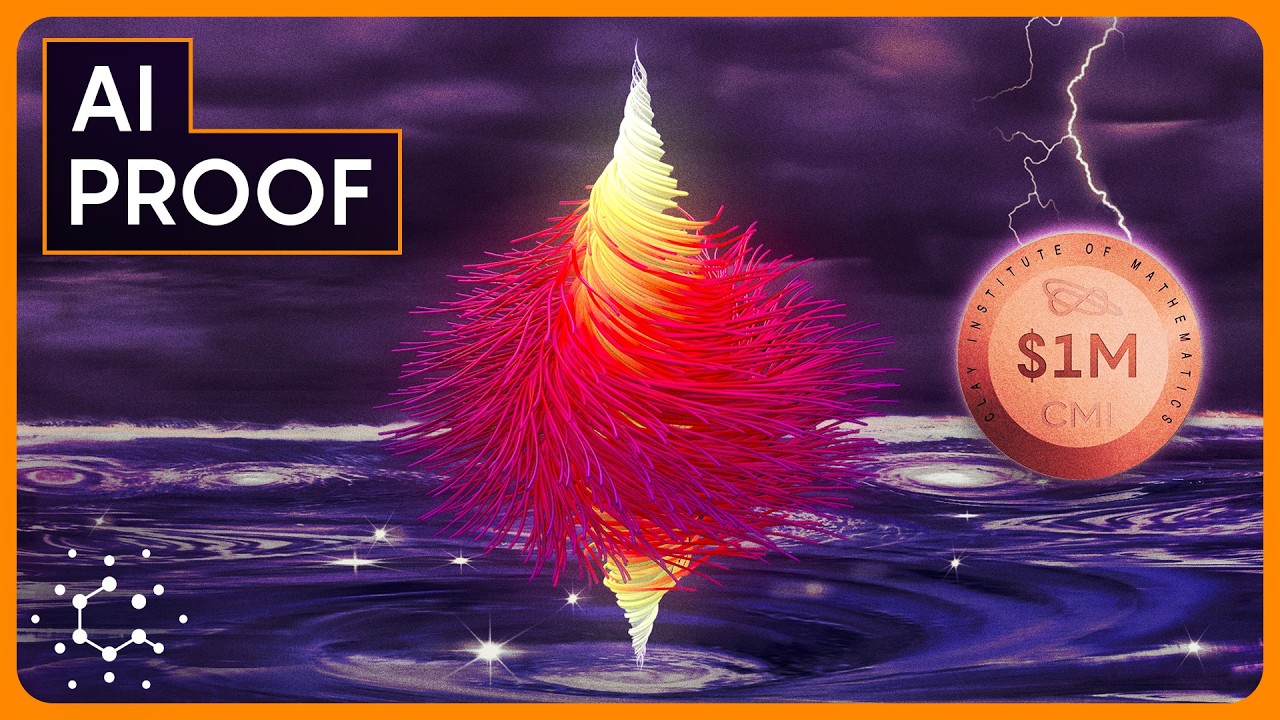
Why Navier-Stokes Pushes Math and Physics to the Edge
The Navier-Stokes equations are among the most important — and most challenging — equations in physics. For centuries, scientists and engineers have used them to describe the motion of fluids, from turbulent air and ocean currents to blood flowing through our bodies. But mathematicians couldn’t prove whether their solutions always remain smooth, a mystery that became one of seven $1 million Millennium Prize Problems.
So, what makes the Navier-Stokes equations so difficult? What happens when their solutions blow up? And how could a new OpenAI proof finally resolve the problem?
We break it all down with Steven Brunton (@Eigensteve), a physicist at the University of Washington, in this comprehensive explainer covering fluid dynamics, turbulence, the new proof, and more.
00:00 Intro to the equations and the Millennium Prize problem
1:19 Building up the Euler equations
3:39: The viscosity term and the full Navier-Stokes equations
5:06: The profound mathematical challenge of turbulence
7:58: Blowup and the Millennium Prize question
9:12: Mathematicians make progress (from Jean Leray to Terence Tao)
10:26: Córdoba and Martínez-Zoroa's unconventional approach
11:28: Buckmaster and Alpöge prove Euler blowup; OpenAI proves blowup in Navier-Stokes
12:36: What does this mean for the equations?
---------
Quanta Magazine is an editorially independent publication supported by the Simons Foundation. We focus on developments in mathematics, theoretical physics, theoretical computer science and the basic life sciences.
So, what makes the Navier-Stokes equations so difficult? What happens when their solutions blow up? And how could a new OpenAI proof finally resolve the problem?
We break it all down with Steven Brunton (@Eigensteve), a physicist at the University of Washington, in this comprehensive explainer covering fluid dynamics, turbulence, the new proof, and more.
00:00 Intro to the equations and the Millennium Prize problem
1:19 Building up the Euler equations
3:39: The viscosity term and the full Navier-Stokes equations
5:06: The profound mathematical challenge of turbulence
7:58: Blowup and the Millennium Prize question
9:12: Mathematicians make progress (from Jean Leray to Terence Tao)
10:26: Córdoba and Martínez-Zoroa's unconventional approach
11:28: Buckmaster and Alpöge prove Euler blowup; OpenAI proves blowup in Navier-Stokes
12:36: What does this mean for the equations?
---------
Quanta Magazine is an editorially independent publication supported by the Simons Foundation. We focus on developments in mathematics, theoretical physics, theoretical computer science and the basic life sciences.

Quanta Magazine
Explore mind-bending developments in basic science and math research. Quanta Magazine is an award-winning, editorially independent magazine published by the Simons Foundation. http://www.quantamagazine.org/
For more information, contact quanta@simonsfoun...