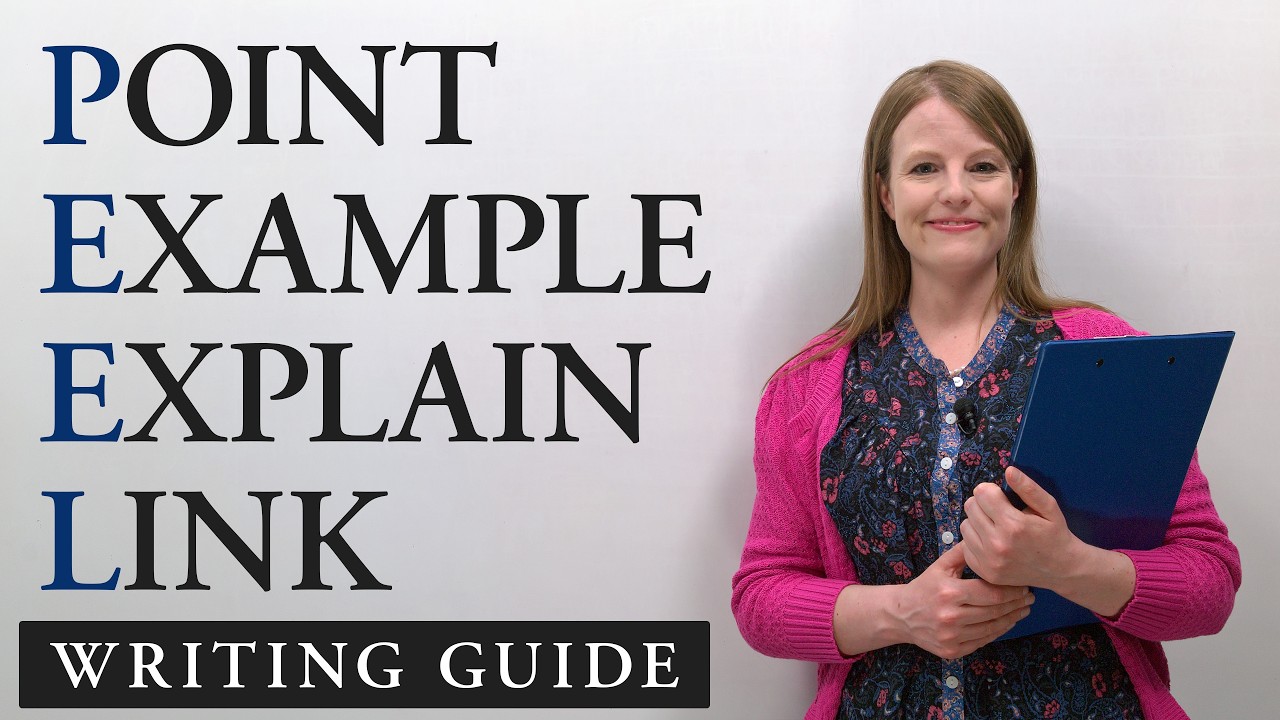
Write Perfect Paragraphs in English: The PEEL Method
Learn the PEEL method and write clear, well-organized paragraphs in English. PEEL stands for:
• P = Point
• E = Example
• E = Explain
• L = Link
In this lesson, you’ll learn what each step means, plus useful words and phrases for each one, like “In my opinion”, “For example”, “As a result”, and “Therefore”. You’ll see how the steps work together in a complete paragraph, and then practice putting a mixed-up paragraph into the correct order. The PEEL framework is great for IELTS Writing Task 2, TOEFL, university and high school essays, and any writing where you need to give your opinion or make an argument. Forget AI. You can write it yourself! Test your understanding with the quiz here: https://www.engvid.com/peel-method-write-perfect-paragraphs/
Next, watch more of my writing lessons:
https://youtu.be/5JvxvKPHu0g
https://youtu.be/o9aVjBHEEbU
In this lesson:
0:00 Write a Perfect Paragraph: The PEEL Method
1:02 POINT: State the Main Idea
2:41 EXAMPLE: Give Evidence or Example
3:46 EXPLAIN: Explain the Example
5:11 LINK: Connect Back to Main Point
6:10 PEEL Method: Full Paragraph Example
7:00 PEEL Method: Practice Building a Paragraph
9:58 Summary
TRANSCRIPT:
My name is Emma, and I want to help you with your writing.
Today, we are going to learn a way to organize your writing to help you with your essays, with things like TOEFL, IELTS, or even university and high school essays.
So what we're talking about is something called the PEEL framework.
So, the first thing I want you to do is forget using AI to write your essays.
You can do this.
You can write.
So, let me teach you about PEEL and how it can help you with your writing.
PEEL stands for point, example, explain, and link.
We're going to look at each of these parts of PEEL in more detail, and then we're going to look at some example paragraphs.
I can't wait.
I love using PEEL, and I think you will, too.
So, the P in PEEL stands for point.
So, what is the point of what you're writing?
So, we often use PEEL when we're writing paragraphs, especially paragraphs where we're trying to make an argument or to give our opinion on something.
So, when I'm talking about point, what I'm really saying is the first sentence you state the main idea.
So, here's an example of how you might start off an essay.
So, imagine somebody asks you to write about exercise and students.
Your point might be, "Exercise is important for students because it improves both their physical and mental health."
Okay, so that's an example of a topic sentence, and these are just some words that can be helpful when you write, when you're giving the point.
"I think that."
"I think that exercise is very important for students."
"One important idea is exercise can help students' mental or physical health."
"In my opinion, exercise is critical for student well-being."
Exercise for students is important because it helps them physically and mentally.
So, there's some different examples of how to use these types of words.
They're great words at the start of a paragraph, especially for IELTS, TOEFL, and high school paragraphs.
So, now let's look at the "E" in PEEL.
The first "E" in PEEL stands for "example".
So, you've already given your point, now you need to back it up with an example.
So, give evidence or an example to prove your point.
So, here are some great words that you can use to help you do this.
You can say "for example", "for instance".
"One example is..."
"This can be seen when..."
So, going back to our exercise point, my point was that exercise is important for students' physical and mental well-being, so that's my point.
"For example, regular exercise can reduce stress and increase energy levels."
So, I'm giving a real example to support my point.
So, you give the point, then you follow it up with an example.
All right, let's see what the next "E" in the PEEL method means.
The next "E" in PEEL, so the second "E", stands for "explain".
So, the next thing you do when you're writing a paragraph is you explain your example more deeply, so you go into more detail.
Here are some words that can be helpful for that.
"This means that..."
"As a result..."
"Because of this..."
"This helps because..."
So, going back to our example from the beginning where I mentioned exercise is important for students' physical and mental well-being, and then I gave an example about how exercise can help with energy, now I'm going to talk about that a little bit more.
So, as a result, students often feel more focused and perform better in class, so I'm giving more detail from the previous example.
And that's what you want to do.
So, you give an example, for instance, and then you give more detail or more of an explanation.
All right, and we will look at more examples in a moment, but let's now get to the final letter in PEEL, which is the "L".
What does "L" stand for? […]

English with Emma · engVid
Hi, my name is Emma, and I'm going to teach you English! Learning a different language can be hard, but it can also be a fun and rewarding experience.
I am TESOL-certified and have taught students from various backgrounds, ages, and levels. From immigran...