5 Leg Changes You Shouldn’t Just Blame on Age
?Get your free anti-inflammatory diet plan here: https://dailyhealthpost.co/fight-inflammation
Cold feet. A sore that won't heal. Legs that just don't keep up like they used to. Most of us blame it on getting older, but these five leg changes can be signs of poor circulation from peripheral artery disease (PAD), a condition linked to a higher risk of heart attack and stroke.
In this video, we count down five leg changes worth taking seriously, from a sore that won't heal to the quiet one that almost nobody connects to their arteries. You'll also learn why the standard ankle test (the ankle-brachial index) can look normal when it isn't, what a toe test is, and what to ask your doctor about.
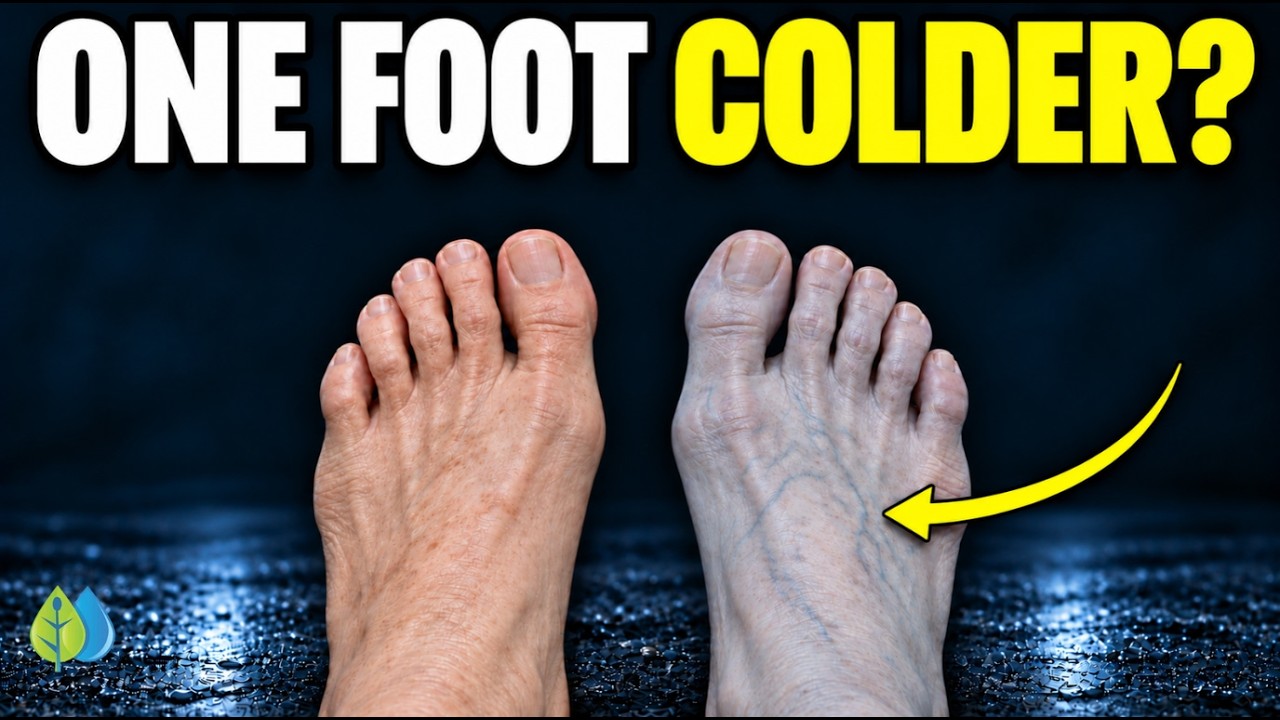
Inside this video: the sore that looks different from a vein sore, color changes and blue toe syndrome, why shiny hairless skin proves less than you'd think, the leg that's colder than the other, and the painless slowdown that's easy to miss.
This video is for education only and is not medical advice. If you notice these changes, talk to your doctor. For sudden severe leg pain or a cold, pale leg, call for emergency care.
Subscribe to DailyHealthPost for more heart and circulation videos.
? Subscribe → https://dailyhealthpost.co/subscribe
0:00 Why these leg changes aren't "just age"
0:43 Number 5: A sore that won't heal
2:20 Number 4: Color changes (and blue toe syndrome)
3:25 Number 3: Shiny, hairless skin
4:24 Number 2: One leg colder, numb or weaker
5:17 Number 1: Legs quietly slowing down
6:42 The ankle test (ankle-brachial index)
7:20 When the ankle test looks fine but isn't
7:40 What to ask for instead
8:36 If artery disease is found: what helps
9:06 What to do next
1. PARTNERS study, JAMA 2001: PAD detection, awareness and treatment in primary care
https://pubmed.ncbi.nlm.nih.gov/11560536/
2. AAFP 2025: Practice guidelines on lower extremity peripheral artery disease
https://www.aafp.org/pubs/afp/issues/2025/1100/practice-guidelines-lower-extremity-peripheral-artery.html
3. AAFP 2019: Peripheral arterial disease, diagnosis and treatment
https://www.aafp.org/pubs/afp/issues/2019/0315/p362.html
4. Cleveland Clinic Journal of Medicine, October 2026
https://www.ccjm.org/content/93/10/603
5. Toe brachial index vs ankle brachial index in type 2 diabetes, Diabetology & Metabolic Syndrome 2024
https://link.springer.com/article/10.1186/s13098-024-01291-2
6. Gardner and Poehlman, JAMA 1995: Exercise rehabilitation programs for claudication
https://pubmed.ncbi.nlm.nih.gov/7674529
7. EURODIALE baseline results, Diabetologia 2007: diabetic foot disease in Europe
https://pubmed.ncbi.nlm.nih.gov/17093942/
8. Lack of lower extremity hair not a predictor for PAD, Archives of Dermatology 2009 (ACFAS summary)
https://www.acfas.org/slr-september-2010-rachel-johnson
9. Peroneal alopecia in men aged 50 and older, Journal of Skin
https://jofskin.org/33014/index.php/skin/article/download/580/pdf/2226
10. McDermott et al., Circulation 2008: Asymptomatic PAD and adverse lower extremity characteristics
https://pubmed.ncbi.nlm.nih.gov/18458172/
11. McDermott et al., JACC 2011: Sedentary hours, walking speed and calf muscle changes in PAD
https://www.jacc.org/doi/10.1016/j.jacc.2010.12.038
12. PAD Pulse Alliance survey (Society for Vascular Surgery), February 2024
https://vascular.org/news-advocacy/articles-press-releases/new-data-70-americans-unaware-common-vascular-disease-one
#PeripheralArteryDisease #PoorCirculation #LegHealth #HeartHealth #SeniorHealth #ArteryHealth #CirculationTips #BloodFlow #FootHealth #PADAwareness #HealthOver60 #LegPain

DailyHealthPost
At DailyHealthPost.com, our mission is to deliver the best information to help our viewers and subscribers optimize their nutrition and health so they can feel amazing naturally! We've been doing this since 2013.
...