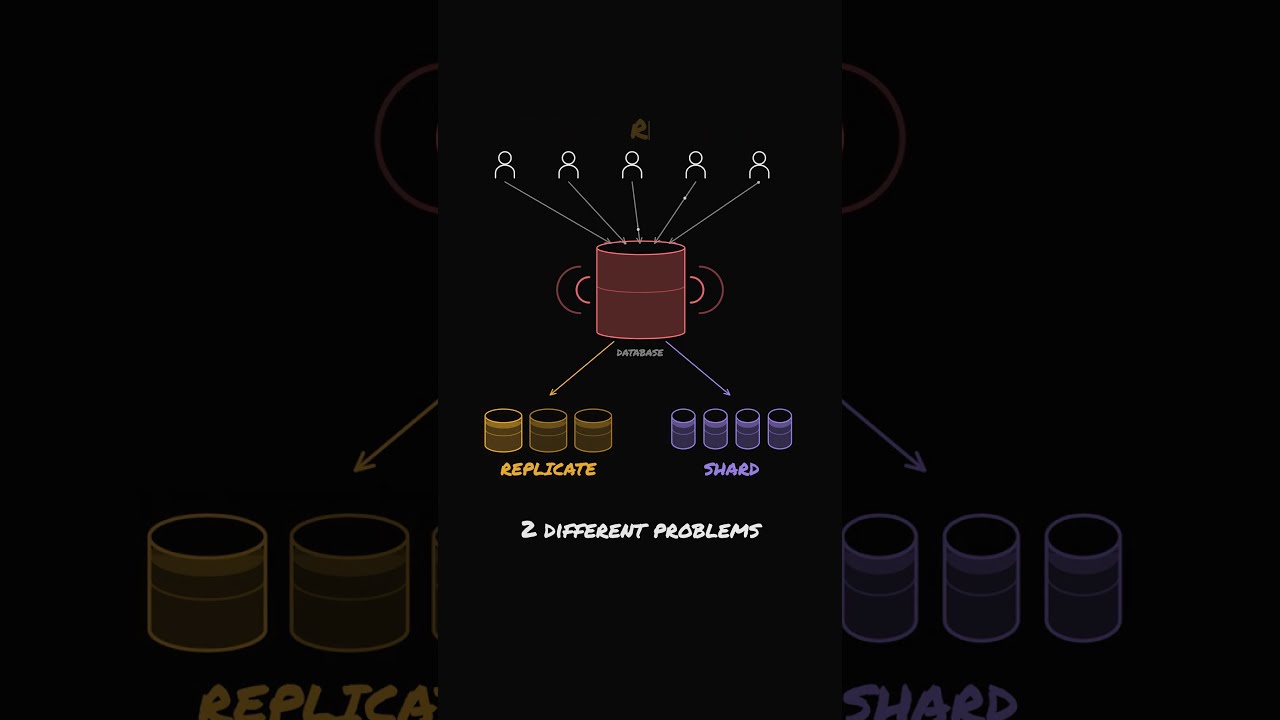
When to Shard Database vs Replicate? Database Scaling Explained.
Most database scaling mistakes come from treating replication and sharding as interchangeable. They solve different problems.
I've seen teams throw sharding at a simple read-heavy bottleneck and buy themselves months of operational pain, resharding, cross-shard queries, and hot partitions when two read replicas would have fixed it. And I've seen the opposite: teams stacking replicas onto a write-heavy system and wondering why the primary is still on fire. Every replica has to apply every write, so replication does nothing for write volume.
The rule is simple. Don't shard until you've exhausted caching and replication. Replication, one primary pushing copies out to read replicas, is the answer for read-heavy workloads like social feeds, and it gives you a standby when the primary dies. Sharding is for when writes or raw data size physically outgrow one machine. You split the data across independent servers, each owning its own slice.
And in mature production systems, it's not either or. You shard first, then replicate each shard. Writes scale across the shards, and every shard survives a machine failure.
Match the fix to the actual bottleneck. Most of the time the bottleneck is reads, and most of the time replicas are enough.
#SystemDesign #Databases #DevOps #BackendDevelopment #SoftwareArchitecture
I've seen teams throw sharding at a simple read-heavy bottleneck and buy themselves months of operational pain, resharding, cross-shard queries, and hot partitions when two read replicas would have fixed it. And I've seen the opposite: teams stacking replicas onto a write-heavy system and wondering why the primary is still on fire. Every replica has to apply every write, so replication does nothing for write volume.
The rule is simple. Don't shard until you've exhausted caching and replication. Replication, one primary pushing copies out to read replicas, is the answer for read-heavy workloads like social feeds, and it gives you a standby when the primary dies. Sharding is for when writes or raw data size physically outgrow one machine. You split the data across independent servers, each owning its own slice.
And in mature production systems, it's not either or. You shard first, then replicate each shard. Writes scale across the shards, and every shard survives a machine failure.
Match the fix to the actual bottleneck. Most of the time the bottleneck is reads, and most of the time replicas are enough.
#SystemDesign #Databases #DevOps #BackendDevelopment #SoftwareArchitecture

KodeKloud
...