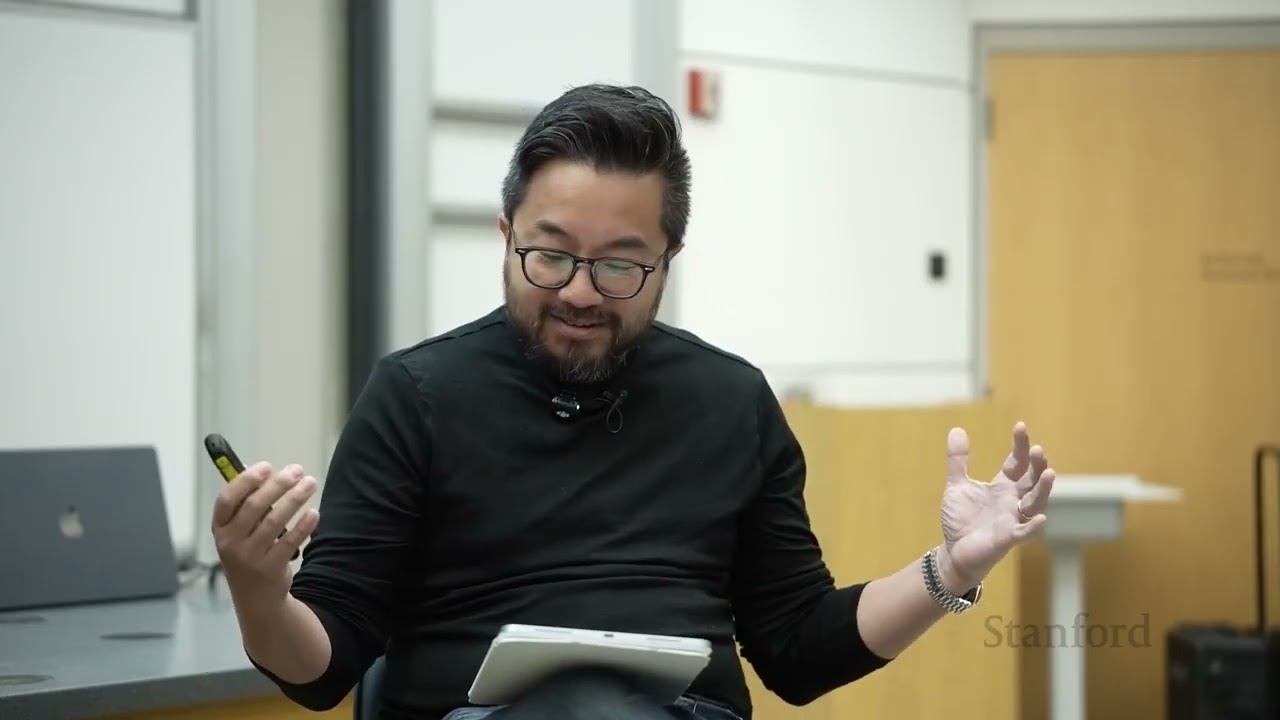
Stanford CS153 Frontier Systems | The AI Native Company: How One Founder Becomes a 1000x Engineer
For more information about Stanford's online Artificial Intelligence programs, visit: https://stanford.io/ai
Follow along with the course schedule and syllabus, visit: https://cs153.stanford.edu/
In a CS153 Frontier Systems lecture, the class shifts from upstream bottlenecks like power and compute to the capital and company-formation layer, framing YC's 2010s introduction of the SAFE as a standardization moment for venture capital comparable to the buildout of the electrical grid.
Guests Garry Tan, CEO of Y Combinator, and General Partner Diana Hu argue that agentic coding, unlocked by Claude 4.5 in late 2025, has collapsed the unit of production: Tan recounts rebuilding his old startup Posterous in five days on a $200 Claude Max plan and shipping his open-source GStack and GBrain projects to over 100,000 GitHub stars. They walk through agentic primitives — skills, resolvers, Skillify, evals, and a three-layer memory system — and map them onto company structure, with skills as employees, resolvers as the org chart, and CheckResolvable as audit and compliance. Hu closes by arguing AI-native companies run as closed-loop systems with one or two million dollars in revenue per employee, citing YC portfolio companies Salient, Happy Robot, and Reducto as forward-deployed examples and pointing to white space across back office, finance, and customer service for one-person frontier companies.
Garry Tan is president and CEO of Y Combinator and a General Partner. He was a partner at Y Combinator from 2011 to 2015, where he built key parts of the YC experience for founders including Bookface and the Demo Day website. Garry is the co-founder of Initialized Capital and Posterous (YC S08), a blog platform acquired by Twitter, and prior to that, he was an early designer and engineering manager at Palantir (NYSE:PLTR), where he designed the company logo. Garry holds a BS in Computer Systems Engineering from Stanford.
Diana Hu is a General Partner at YC. She was co-founder and CTO of Escher Reality (YC S17), an Augmented Reality Backend company that was acquired by Niantic (makers of Pokémon Go). At Niantic, she was the head of the AR platform. Previously, she led data science at OnCue TV that was sold to Verizon. Originally from Chile, Diana graduated from Carnegie Mellon University with a BS and MS in Electrical and Computer Engineering with a focus in computer vision and machine learning.
Follow the playlist: https://youtube.com/playlist?list=PLoROMvodv4rN447WKQ5oz_YdYbS74M5IA&si=DOJ5amlyRdyMJBhG
Follow along with the course schedule and syllabus, visit: https://cs153.stanford.edu/
In a CS153 Frontier Systems lecture, the class shifts from upstream bottlenecks like power and compute to the capital and company-formation layer, framing YC's 2010s introduction of the SAFE as a standardization moment for venture capital comparable to the buildout of the electrical grid.
Guests Garry Tan, CEO of Y Combinator, and General Partner Diana Hu argue that agentic coding, unlocked by Claude 4.5 in late 2025, has collapsed the unit of production: Tan recounts rebuilding his old startup Posterous in five days on a $200 Claude Max plan and shipping his open-source GStack and GBrain projects to over 100,000 GitHub stars. They walk through agentic primitives — skills, resolvers, Skillify, evals, and a three-layer memory system — and map them onto company structure, with skills as employees, resolvers as the org chart, and CheckResolvable as audit and compliance. Hu closes by arguing AI-native companies run as closed-loop systems with one or two million dollars in revenue per employee, citing YC portfolio companies Salient, Happy Robot, and Reducto as forward-deployed examples and pointing to white space across back office, finance, and customer service for one-person frontier companies.
Garry Tan is president and CEO of Y Combinator and a General Partner. He was a partner at Y Combinator from 2011 to 2015, where he built key parts of the YC experience for founders including Bookface and the Demo Day website. Garry is the co-founder of Initialized Capital and Posterous (YC S08), a blog platform acquired by Twitter, and prior to that, he was an early designer and engineering manager at Palantir (NYSE:PLTR), where he designed the company logo. Garry holds a BS in Computer Systems Engineering from Stanford.
Diana Hu is a General Partner at YC. She was co-founder and CTO of Escher Reality (YC S17), an Augmented Reality Backend company that was acquired by Niantic (makers of Pokémon Go). At Niantic, she was the head of the AR platform. Previously, she led data science at OnCue TV that was sold to Verizon. Originally from Chile, Diana graduated from Carnegie Mellon University with a BS and MS in Electrical and Computer Engineering with a focus in computer vision and machine learning.
Follow the playlist: https://youtube.com/playlist?list=PLoROMvodv4rN447WKQ5oz_YdYbS74M5IA&si=DOJ5amlyRdyMJBhG

Stanford Online
You can gain access to a world of education through Stanford Online, the Stanford School of Engineering’s portal for academic and professional education offered by schools and units throughout Stanford University. https://online.stanford.edu/
Our robust ...
Stanford CS336 Language Modeling from Scratch | Spring 2026 | Lecture 12: Evaluation
Stanford Online
Stanford Online AI Programs Top Questions: Enrolling in Online Courses vs Self Study
Stanford Online
Stanford CS336 Language Modeling from Scratch | Spring 2026 | Lecture 8: Parallelism
Stanford Online
Stanford CS336 Language Modeling from Scratch | Spring 2026 | Lecture 7: Parallelism
Stanford Online