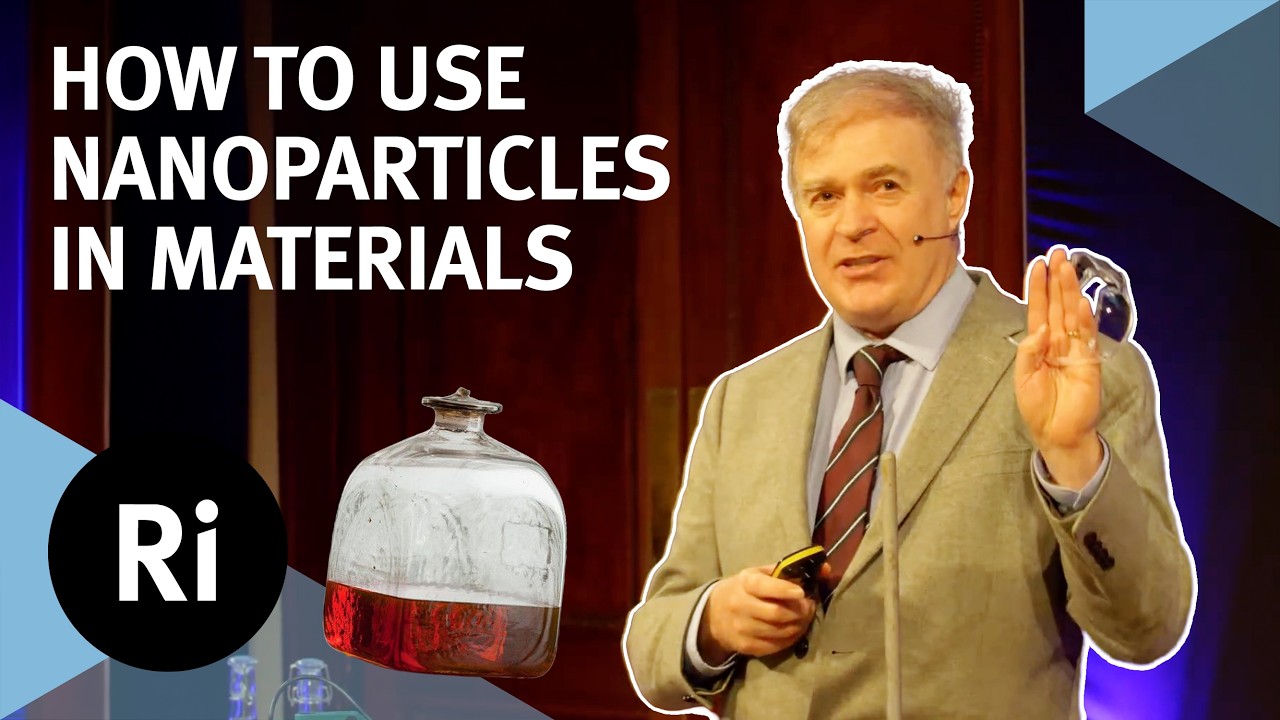
How nanoparticles are quietly revolutionising the world | with Ivan Parkin
What if the glass in your conservatory was quietly cleaning itself right now? It probably is — and it's all down to a coating just 25 nanometres thick.
The talk was livestreamed and filmed at the Ri on 24th April 2026, in celebration of UCL's 200th anniversary.
Professor Ivan Parkin — one of the world's leading materials chemists, with over 1,000 publications and an h-index of 126 — takes us from Michael Faraday's ruby gold experiments in this very building in 1857, through to the cutting-edge nanoparticle science reshaping medicine, clean energy, air quality monitoring and building design today.
Along the way there are live demonstrations: water droplets bouncing off superhydrophobic surfaces, gold nanoparticles forming in real time, and cotton wool submerged in dye emerging completely pristine.
—
Support the channel by becoming a member and unlock exclusive content:
https://www.youtube.com/channel/UCYeF244yNGuFefuFKqxIAXw/join
Subscribe for regular science videos: http://bit.ly/RiSubscRibe
—
Chapters:
0:00 Introduction and Faraday's ruby gold
1:47 Faraday's original gold solutions — still intact after 170 years
3:10 What is a nanoparticle? Scale and size explained
4:10 UCL at 200: Nobel prizes, firsts and the Ri connection
6:27 Oscillating reactions demonstration begins
7:01 George Porter, the Ri and a personal history
9:35 Titanium dioxide: the photocatalytic self-cleaning coating
10:08 Pilkington Activ self-cleaning glass — live demonstration
13:29 How float glass is made and why TiO2 coatings work
15:00 Improving titanium dioxide: nitrogen, sulfur and hetrojunctions
18:09 Tungsten oxide and titanium dioxide: a 10x jump in photoactivity
21:35 Zinc ion batteries and nanoparticle dendrite growth
23:09 Superhydrophobic surfaces explained
26:28 Live demo: water droplets on the racetrack
27:49 Live demo: cotton wool and grape juice — treated vs untreated
30:52 The lotus effect and how plants do it naturally
32:02 Photodiodes: splitting water into hydrogen and oxygen with light
34:13 Gas sensing and the Aeroqual air quality network
38:13 Radiative cooling coatings — coming to London buses
43:11 Healthcare-acquired infections and antimicrobial surfaces
44:46 Gold nanoparticles that destroy MRSA and E. coli using light
48:25 Live demo: making gold nanoparticles in real time
51:07 SERS and PIERS: detecting explosives at trace levels
54:23 Photoacoustic imaging probes smaller than a full stop
56:27 Magnetic nanoparticles for breast cancer detection
58:43 John Meurig Thomas and an unusual impersonation story
59:54 Summary and close
—
Professor Ivan Parkin is The Sir William Ramsay Professor of Chemistry and Dean of the Faculty of Mathematical and Physical Sciences at University College London (UCL). His research focuses on functional thin films, self-cleaning glass, and antimicrobial coatings. With over 1,000 publications, an h-index of 126, and more than 150 PhD students supervised, his work spans fundamental materials chemistry to real-world commercialisation — including the world's first commercial self-cleaning glass. He is a Fellow of the Royal Society of Chemistry and a member of Academia Europaea.
—
The Royal Institution is a world-leading science education charity with a 200-year history of bringing the public face-to-face with leading scientists. Support us: https://www.rigb.org/support-us
#Nanoparticles #MaterialsScience #Chemistry #SelfCleaningGlass #RoyalInstitution #UCL200 #sciencetalk
The Ri is on Twitter: http://twitter.com/ri_science
and Facebook: http://www.facebook.com/royalinstitution
and TikTok: https://www.tiktok.com/@ri_science
Listen to the Ri podcast: https://podcasters.spotify.com/pod/show/ri-science-podcast
Donate to the RI and help us bring you more lectures: https://www.rigb.org/support-us/donate-ri
Our editorial policy: https://www.rigb.org/editing-ri-talks-and-moderating-comments
Subscribe for the latest science videos: http://bit.ly/RiNewsletter
Product links on this page may be affiliate links which means it won't cost you any extra but we may earn a small commission if you decide to purchase through the link.
The talk was livestreamed and filmed at the Ri on 24th April 2026, in celebration of UCL's 200th anniversary.
Professor Ivan Parkin — one of the world's leading materials chemists, with over 1,000 publications and an h-index of 126 — takes us from Michael Faraday's ruby gold experiments in this very building in 1857, through to the cutting-edge nanoparticle science reshaping medicine, clean energy, air quality monitoring and building design today.
Along the way there are live demonstrations: water droplets bouncing off superhydrophobic surfaces, gold nanoparticles forming in real time, and cotton wool submerged in dye emerging completely pristine.
—
Support the channel by becoming a member and unlock exclusive content:
https://www.youtube.com/channel/UCYeF244yNGuFefuFKqxIAXw/join
Subscribe for regular science videos: http://bit.ly/RiSubscRibe
—
Chapters:
0:00 Introduction and Faraday's ruby gold
1:47 Faraday's original gold solutions — still intact after 170 years
3:10 What is a nanoparticle? Scale and size explained
4:10 UCL at 200: Nobel prizes, firsts and the Ri connection
6:27 Oscillating reactions demonstration begins
7:01 George Porter, the Ri and a personal history
9:35 Titanium dioxide: the photocatalytic self-cleaning coating
10:08 Pilkington Activ self-cleaning glass — live demonstration
13:29 How float glass is made and why TiO2 coatings work
15:00 Improving titanium dioxide: nitrogen, sulfur and hetrojunctions
18:09 Tungsten oxide and titanium dioxide: a 10x jump in photoactivity
21:35 Zinc ion batteries and nanoparticle dendrite growth
23:09 Superhydrophobic surfaces explained
26:28 Live demo: water droplets on the racetrack
27:49 Live demo: cotton wool and grape juice — treated vs untreated
30:52 The lotus effect and how plants do it naturally
32:02 Photodiodes: splitting water into hydrogen and oxygen with light
34:13 Gas sensing and the Aeroqual air quality network
38:13 Radiative cooling coatings — coming to London buses
43:11 Healthcare-acquired infections and antimicrobial surfaces
44:46 Gold nanoparticles that destroy MRSA and E. coli using light
48:25 Live demo: making gold nanoparticles in real time
51:07 SERS and PIERS: detecting explosives at trace levels
54:23 Photoacoustic imaging probes smaller than a full stop
56:27 Magnetic nanoparticles for breast cancer detection
58:43 John Meurig Thomas and an unusual impersonation story
59:54 Summary and close
—
Professor Ivan Parkin is The Sir William Ramsay Professor of Chemistry and Dean of the Faculty of Mathematical and Physical Sciences at University College London (UCL). His research focuses on functional thin films, self-cleaning glass, and antimicrobial coatings. With over 1,000 publications, an h-index of 126, and more than 150 PhD students supervised, his work spans fundamental materials chemistry to real-world commercialisation — including the world's first commercial self-cleaning glass. He is a Fellow of the Royal Society of Chemistry and a member of Academia Europaea.
—
The Royal Institution is a world-leading science education charity with a 200-year history of bringing the public face-to-face with leading scientists. Support us: https://www.rigb.org/support-us
#Nanoparticles #MaterialsScience #Chemistry #SelfCleaningGlass #RoyalInstitution #UCL200 #sciencetalk
The Ri is on Twitter: http://twitter.com/ri_science
and Facebook: http://www.facebook.com/royalinstitution
and TikTok: https://www.tiktok.com/@ri_science
Listen to the Ri podcast: https://podcasters.spotify.com/pod/show/ri-science-podcast
Donate to the RI and help us bring you more lectures: https://www.rigb.org/support-us/donate-ri
Our editorial policy: https://www.rigb.org/editing-ri-talks-and-moderating-comments
Subscribe for the latest science videos: http://bit.ly/RiNewsletter
Product links on this page may be affiliate links which means it won't cost you any extra but we may earn a small commission if you decide to purchase through the link.

The Royal Institution
Videos to make you think more deeply about science. Explosive short films, full length talks from the world’s leading scientists and writers, and videos to challenge the way you look at the world.
The Royal Institution is a 200 year old independent chari...