gRPC vs REST APIs #devops #coding
gRPC vs REST: Building a Ride-Sharing App Backend! ?
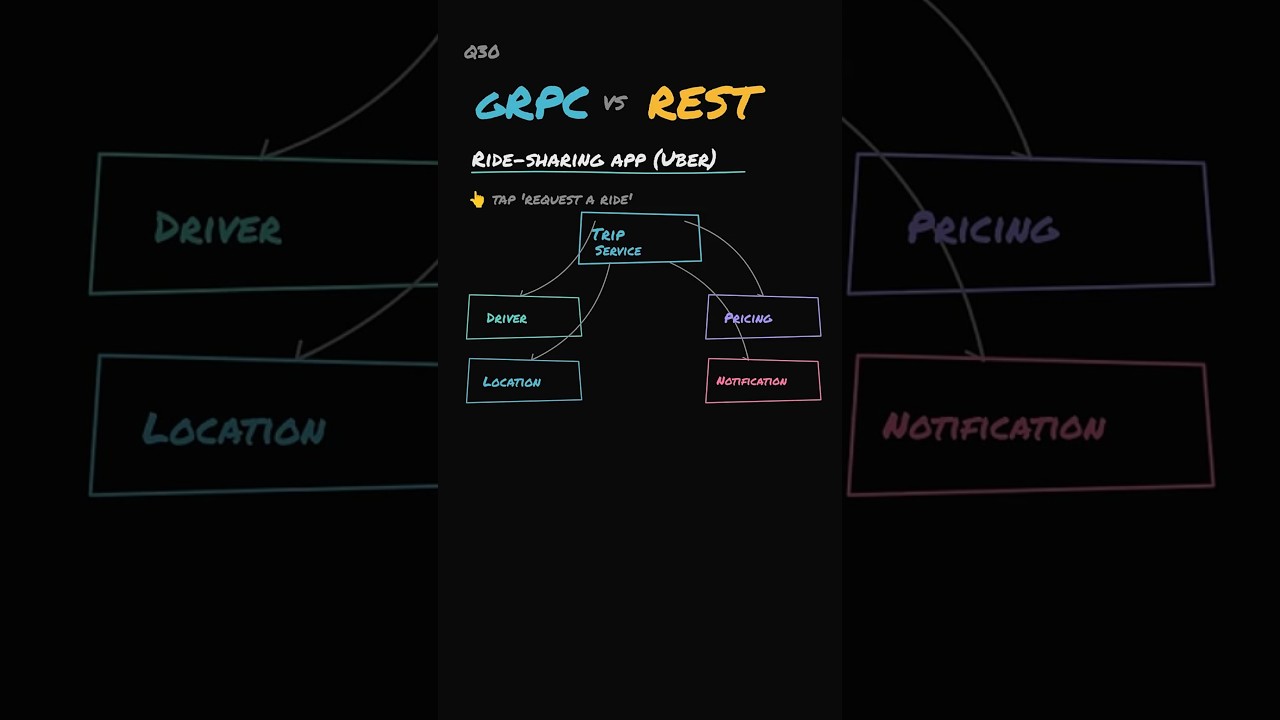
In high-scale systems like a ride-sharing app, production architectures usually deploy a hybrid model: RESTful APIs for client-facing traffic and gRPC for internal microservices. REST relies on human-readable JSON, making it the perfect choice for mobile apps and web browsers that need simple debugging. However, JSON payloads are bulky, API documentation easily drifts out of date, and real-time streaming requires resource-heavy workarounds like WebSockets or continuous polling.
To supercharge the backend, gRPC handles microservice-to-microservice communication by replacing JSON with ultra-compact binary Protocol Buffers (Protobuf) running over HTTP/2. It utilizes proto files to enforce strict, compiler-verified service contracts that guarantee your code and documentation never drift, while natively supporting low-overhead data streaming over a single connection. Because web browsers can't communicate with gRPC directly—as JavaScript cannot access the required low-level HTTP/2 streams—using REST at the gateway and gRPC on the inside gives you the ultimate balance of client flexibility and backend velocity.
#SystemDesign #gRPC #RESTAPI #Microservices #BackendDevelopment #SoftwareArchitecture
#devops #Protobuf #HTTP2 #API #WebDevelopment #coding
In high-scale systems like a ride-sharing app, production architectures usually deploy a hybrid model: RESTful APIs for client-facing traffic and gRPC for internal microservices. REST relies on human-readable JSON, making it the perfect choice for mobile apps and web browsers that need simple debugging. However, JSON payloads are bulky, API documentation easily drifts out of date, and real-time streaming requires resource-heavy workarounds like WebSockets or continuous polling.
To supercharge the backend, gRPC handles microservice-to-microservice communication by replacing JSON with ultra-compact binary Protocol Buffers (Protobuf) running over HTTP/2. It utilizes proto files to enforce strict, compiler-verified service contracts that guarantee your code and documentation never drift, while natively supporting low-overhead data streaming over a single connection. Because web browsers can't communicate with gRPC directly—as JavaScript cannot access the required low-level HTTP/2 streams—using REST at the gateway and gRPC on the inside gives you the ultimate balance of client flexibility and backend velocity.
#SystemDesign #gRPC #RESTAPI #Microservices #BackendDevelopment #SoftwareArchitecture
#devops #Protobuf #HTTP2 #API #WebDevelopment #coding

KodeKloud
...